



































If you run a B2B business, you already know: “Trust is built in drops and lost in buckets.”
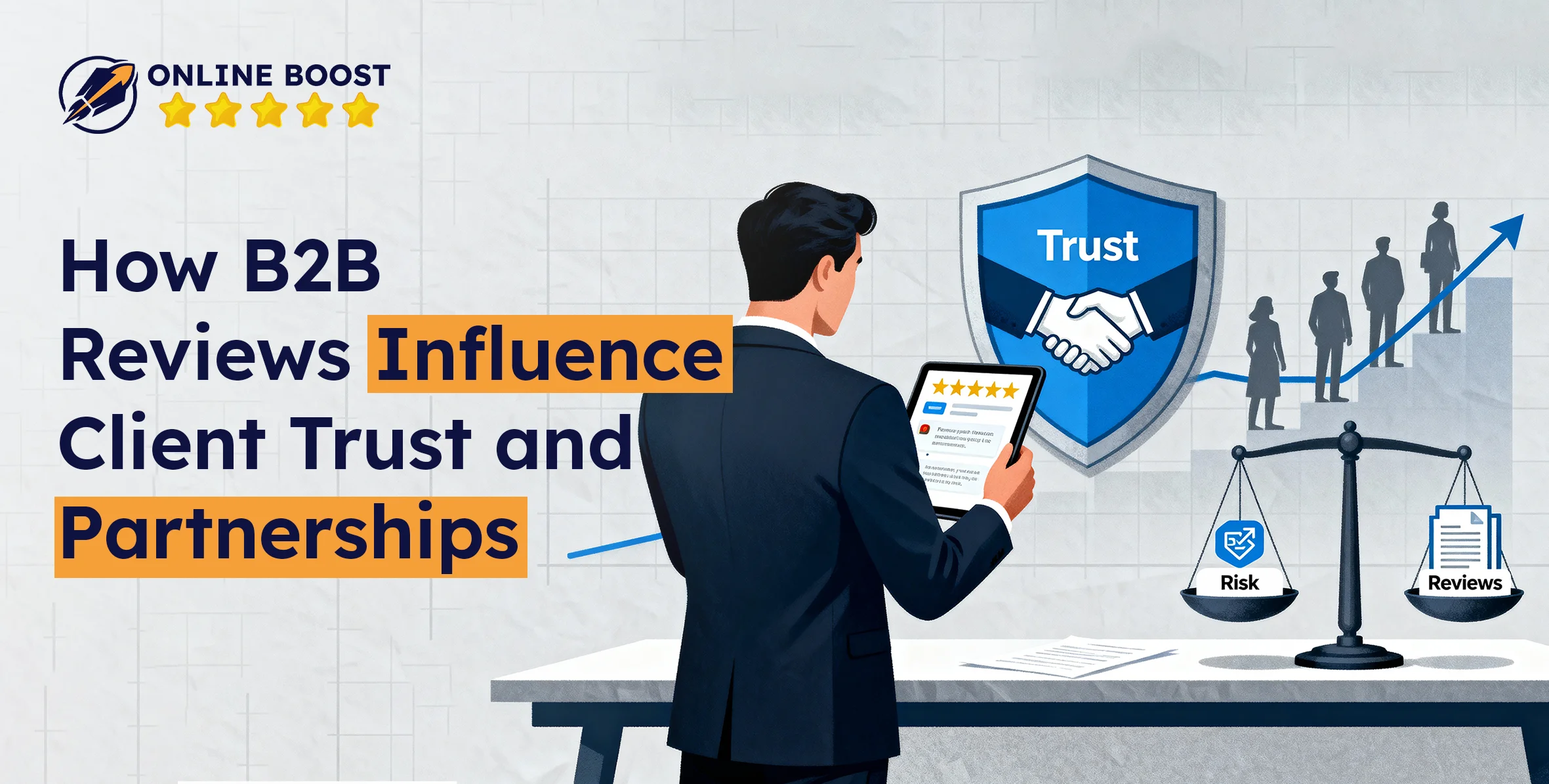
Before a client signs a contract, books a demo, or even replies to your proposal, they do something very human. They look for proof that other businesses trusted you first. That is why it is critical to understand the importance of B2B reviews.
Your website might be beautiful, your pitch might be sharp, and your team might genuinely deliver. But buyers are cautious. Research shows that only 9% of buyers consider vendor websites a reliable source of information, which basically means “we like your site, but we do not fully believe it yet.” That is the real importance of B2B reviews.
And buyers are doing that risk math more than ever. In a B2B trust study referenced by Clutch, 43% of B2B buyers said they make defensive purchase decisions over 70% of the time.
Read that again, because it explains the psychology behind B2B client trust. Most clients are not hunting for the “best” vendor first. They are trying to avoid the wrong one.
This is exactly how B2B reviews build trust: they answer the question your prospects rarely ask out loud, “Will this partner make me look smart, or will they become a problem I have to explain?”
Why Reviews Matter in B2B Purchasing Decisions
When you look at how B2B decisions are actually made, reviews matter for reasons that go far beyond marketing. They influence how safe, credible, and reliable your business feels to another business that is about to invest real money and reputation into a partnership.
Reduce perceived risk before the first conversation
B2B purchases are rarely impulse decisions. They usually involve higher budgets, longer contracts, and multiple stakeholders. Before a buyer even agrees to a call, they want reassurance that choosing you will not backfire internally. When prospects see other companies sharing real experiences, timelines, and outcomes, it lowers their anxiety.
Act as third-party validation
No matter how honest your messaging is, buyers know it comes from you. Reviews feel different because they are not controlled by your brand voice. They function as independent confirmation that your claims hold up in real-world scenarios.
Influence shortlisting and final selection decisions
In most B2B buying journeys, only a few vendors make it to the final shortlist. Reviews often determine who gets that opportunity. When buyers compare similar offerings, reviews become a differentiator that feels practical and grounded.
Provide trust signals that buyers can justify internally
B2B decisions are rarely made alone. Buyers need to justify their choice to partners, managers, or leadership teams. Reviews give them concrete trust signals that they can point to. Saying “this vendor has consistently positive feedback from similar businesses” sounds far more defensible than “I had a good feeling about them.”
Support long-term reputation,
Reviews are not only about winning the next contract. Over time, they shape how your brand is perceived in the market. A consistent flow of credible feedback supports effective B2B reputation management, which influences future deals, renewals, and referrals.
How B2B Reviews Build (or Break) Trust
Trust in B2B does not appear overnight. It forms step by step, often before a buyer ever speaks to you.
Shape the first impression before direct contact
In many cases, reviews are the first unfiltered exposure a buyer has to your business. Before a call, proposal, or demo, buyers scan feedback to see how others describe working with you. This is one of the most practical ways of how B2B reviews build trust.
Show consistency and reliability over time
Buyers are not only asking whether you can deliver once, but also whether you can deliver repeatedly. A steady flow of online reviews over time shows that your business does not rely on one successful project or a few happy clients. Instead, it suggests repeatable processes and dependable outcomes.
Provide context that buyers cannot get from marketing content
Your service pages explain what you offer. Reviews explain how it actually feels to work with you. This distinction matters. Real feedback mentions communication style, problem-solving approach, and how challenges were handled.
Reinforce credibility through third-party platforms
Trust grows faster when feedback appears on independent platforms rather than only on a company website. Getting Clutch reviews or GoodFirms reviews reassures buyers that the feedback is not selectively presented. These platforms include verified project details, which helps buyers feel more secure in their evaluation.
Expose red flags when trust is weak or damaged
Repeated complaints about missed deadlines, poor communication, or unmet expectations raise concerns quickly. Buyers pay attention to how businesses respond as well. Defensive or dismissive replies do more damage than the original feedback.
Influence emotional confidence
Even in B2B, decisions are not purely rational. Buyers want to feel confident that choosing you will not create future stress or internal conflict. Positive B2B customer reviews create emotional reassurance. Negative or absent reviews do the opposite.
How Reviews Influence B2B Partnerships (Not Just First-Time Deals)

In B2B, trust does not stop working after the first contract is signed. Partnerships evolve over time, and reviews continue to influence how those relationships grow, renew, or quietly fade away.
Set expectations before a partnership begins
Reviews shape what a client expects from you long before onboarding starts. When feedback consistently mentions clear communication, strategic thinking, or reliable delivery, clients enter the partnership with aligned expectations.
Reinforce confidence during ongoing engagements
During long-term projects, clients periodically reassess their decisions, especially when challenges arise. At these moments, reviews act as reassurance. Seeing that other businesses experienced similar challenges and still achieved positive outcomes reinforces the belief that they chose the right partner.
Influence renewals and contract extensions
When renewal time approaches, decision-makers revisit external signals before committing again. Updated online reviews help validate that your service quality has remained consistent.
Support referrals and network-based growth
B2B partnerships expand through introductions and referrals. When a satisfied client recommends you, the next business usually checks your reputation before moving forward.
Position your business as a long-term partner,
Consistent, detailed B2B customer reviews show that businesses stay with you, not just try you once. This perception shifts how prospects view your role. You are no longer seen as a transactional service provider, but as a reliable partner.
Protect partnerships during leadership or team changes
In B2B, relationships outlive individual contacts. When new stakeholders step in, they look for external validation to maintain confidence. Reviews provide that continuity. They act as documented proof of reliability, which preserves trust even when internal dynamics change.
What Types of Reviews Influence B2B Clients the Most
Not all reviews carry the same weight in B2B decision-making. Business buyers look for depth, relevance, and signals that help them judge whether a partnership will work in the real world.
Customer Reviews
Customer reviews are the first thing buyers look for because they feel spontaneous and less controlled. Detailed B2B customer reviews that mention specific challenges and outcomes help buyers quickly assess whether your business understands problems similar to theirs.
These reviews play a strong role in early-stage trust and directly support B2B client trust by answering the question, “What was it actually like to work with them?”
Case Studies
Case studies influence buyers at a more analytical stage. They provide structure, context, and measurable outcomes, which appeal to decision-makers who need evidence they can defend internally. While case studies are usually produced by the business itself, buyers still value them because they show process, strategy, and results.
Testimonials
Testimonials are somewhere between reviews and case studies. They are usually shorter and more controlled, but they still matter. A strong testimonial can reinforce positive feelings and provide emotional reassurance, especially when it comes from a recognizable brand or industry peer.
Third-Party Platform
Reviews published on independent platforms influence buyers more than content hosted on a company website. Feedback on platforms such as Clutch reviews and GoodFirms reviews feels more transparent and harder to manipulate. Buyers trust these sources because they include verification steps and project details, which adds another layer of credibility.
The Combination
B2B clients rarely rely on just one type of review. They scan customer reviews for quick validation, study case studies for proof, and read testimonials for reassurance. Together, these elements form strong trust signals for B2B companies.
Where B2B Clients Check Reviews

Before reaching out or shortlisting a vendor, B2B buyers usually scan a few trusted places to validate what they have already seen on a website or heard through referrals.
Key Review Platforms for B2B Companies
These platforms are commonly checked when buyers want verified feedback, project details, and comparisons between service providers:
Industry Directories and Marketplaces
In addition to review platforms, buyers explore industry-specific directories and marketplaces to compare vendors within a niche
How Many Reviews Are Enough to Build Credibility
Based on buyer behavior studies and platform benchmarks, here is what generally satisfies trust expectations:
- 10–15 reviews: Minimum threshold to avoid looking unproven
- 20–30 reviews: Strong enough to build initial B2B client trust
- 30–50+ reviews: High credibility and competitive positioning
- Recent reviews within the last 3–6 months: More important than total count
- Average rating between 4.0 and 4.7: Seen as trustworthy and realistic
- Detailed, experience-based reviews: Carry more weight than short praise
How to Improve Your B2B Review Strategy
Here are the most practical ways to do that.
Ask at the right moment: The best time to request feedback is right after a successful milestone, project completion, or positive result. At this stage, clients clearly remember the value you delivered, which leads to more detailed and authentic customer reviews.
Guide clients on what to share: Many clients want to help but do not know what to write. Encourage them to mention the problem they had, how you worked together, and the outcome.
Focus on platforms your buyers already trust: Instead of spreading efforts everywhere, prioritize platforms that B2B buyers actually check, such as Clutch reviews, GoodFirms reviews, and other relevant online reviews for B2B businesses.
Respond to every review: Thank clients for positive feedback and address concerns calmly when criticism appears. This is a core part of effective B2B reputation management.
Build consistency: A steady flow of online reviews over time is more powerful than a sudden spike. Consistency shows reliability and long-term performance, which directly influences B2B buyers during evaluation.