





































If you run a healthcare business, here is the truth you already feel but might not have named: health reviews have become the modern front desk. They are the first conversation a patient has with your practice, before your phone rings and before your website even gets a real chance to persuade.
Patients are not casually skimming. They are researching properly. Press Ganey reports that people read an average of 4.7 reviews before deciding on a provider, and even with a referral in hand, 83.5% at least occasionally check reviews to validate that recommendation.
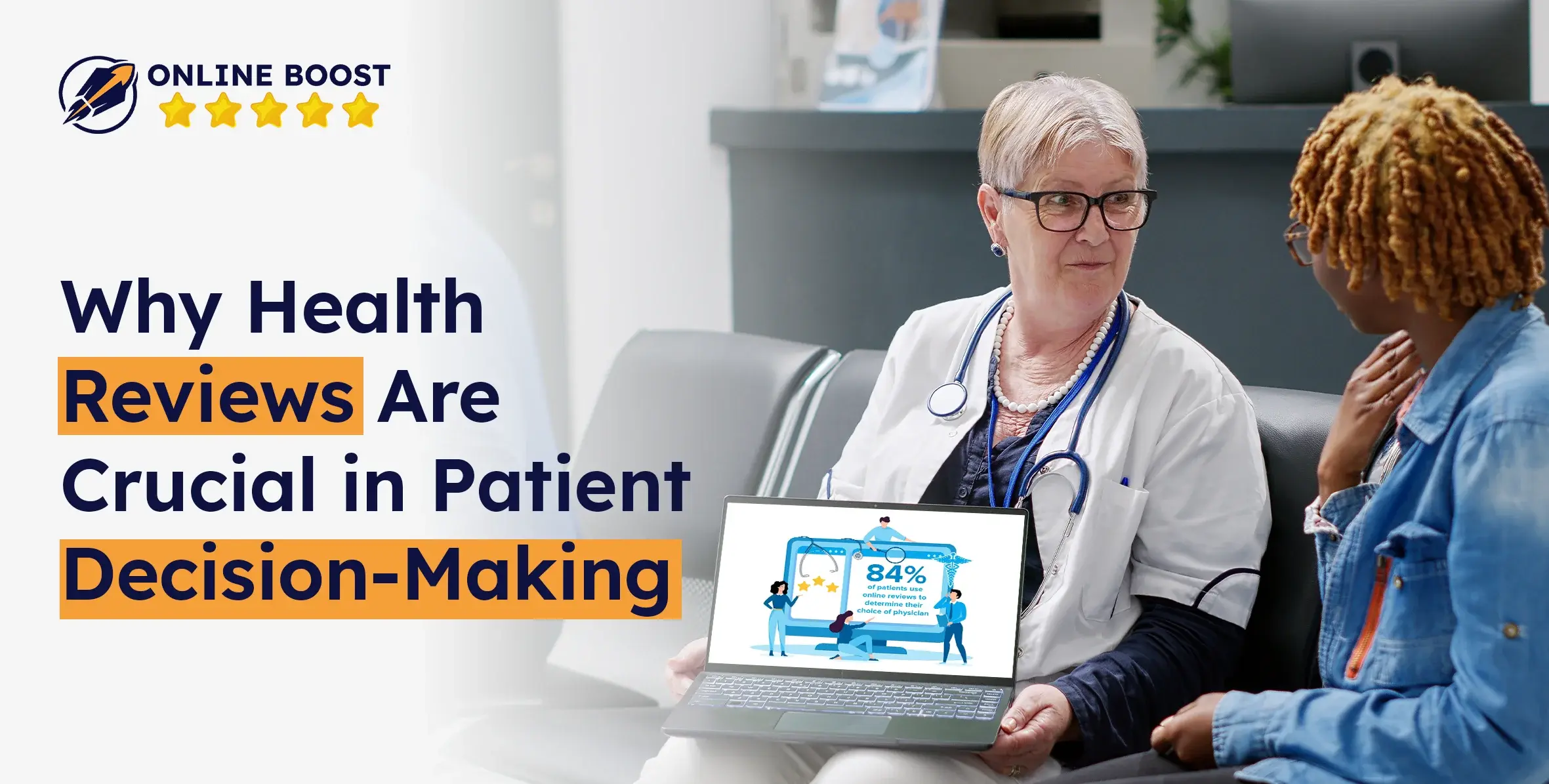
Another Press Ganey research found that 84% of respondents would not consider a physician rated under 4 stars. That is a filter that can quietly remove you from consideration without you ever knowing you were compared.
Now think about what that means for patient decision-making in the United States. When someone searches late at night, trying to pick a doctor, a clinic, or a specialist, your reputation is being “experienced” through online health reviews, not through your mission statement. And when those reviews feel real, specific, and consistent, they create confidence that marketing cannot manufacture.
This is also why Healthgrades reviews and other major healthcare review platforms matter so much.
What Health Reviews Are
At the simplest level, health reviews are direct reflections of real patient experiences. They are written accounts shared by patients after interacting with a doctor, hospital, clinic, or healthcare service. These reviews explain what actually happened, how the patient felt, and whether their expectations were met.
For patients, these reviews act like guidance from someone who has already walked the path they are about to take. For healthcare businesses, they function as public proof of how care is delivered beyond clinical outcomes.
In practical terms, healthcare reviews usually include a combination of the following elements:
- A rating, most often on a five-star scale, that summarizes the overall experience
- Written feedback describing communication, bedside manner, wait times, staff behavior, and follow-up care
- Comments about trust, clarity of explanations, and how comfortable the patient felt during treatment
- In some cases, responses from the healthcare provider addressing feedback or concerns
Note: It is important to understand that medical reviews are not meant to evaluate clinical skill in isolation. Patients are rarely qualified to judge technical accuracy, but they are highly capable of judging how they were treated, how informed they felt, and whether their concerns were taken seriously.
Types of Health Reviews
Not all health reviews serve the same purpose. Patients read different types of reviews depending on what decision they are trying to make, and each type answers a specific question in their mind.
- Doctor reviews: These focus on the individual provider. Patients talk about communication style, listening skills, clarity of explanations, and overall trust. These reviews strongly influence patient decision-making when choosing a primary care physician or specialist.
- Hospital reviews: Hospital reviews look at the bigger picture. Patients mention cleanliness, staff coordination, discharge process, emergency wait times, and overall care experience.
- Clinic and practice reviews: These reviews combine provider experience with operational factors. Scheduling, front-desk interactions, billing clarity, and follow-up care are common themes in this type.
- Treatment or procedure-specific reviews: Some patient reviews focus on a specific service, such as physical therapy, cosmetic procedures, or diagnostic testing. These reviews help patients compare outcomes, recovery experiences, and expectations.
- Telehealth and virtual care reviews: With the growth of remote care, patients increasingly review ease of access, technology, and communication quality during virtual visits.
Why Health Reviews Are Crucial in Patient Decision-Making
Let’s discuss why health reviews carry so much weight and why they directly shape how patients choose one provider over another.
Reduce Fear and Uncertainty at the Moment of Choice
Healthcare decisions are rarely neutral. Patients are often scared, stressed, or already dealing with discomfort. Reviews act as emotional anchors. When people read real experiences from others, it reduces the fear of the unknown and makes the decision much safer.
Act as Social Proof Patients Trust More Than Marketing
Patients know advertising exists to persuade. Reviews exist to share experiences. When a potential patient sees consistent feedback across patient reviews, it validates that the experience they are being promised actually happens. This is why reviews outweigh your website copy when it comes to trust.
Help Patients Compare Providers
Patients are not only choosing care. They are choosing communication style, respect, time, and convenience. Reviews allow side-by-side comparison based on real-life factors such as wait times, clarity of explanations, and staff behavior.
Influence Perceived Quality of Care
Even when patients cannot judge clinical accuracy, they can judge how care feels. Did the provider listen? Were questions answered? Was the process explained clearly? These signals strongly shape perception. Over time, consistent healthcare reviews build an expectation of quality that patients rely on when making choices.
Build Trust Before the First Interaction
Reviews allow patients to start trusting you before they ever speak to your staff. Platforms like Healthgrades reviews play a key role here, because patients already view them as credible sources. If trust is established early, patients are far more likely to book and follow through.
Validate Referrals and Second Opinions
Even with referrals, patients double-check. Reviews help them confirm whether a recommendation aligns with others’ experiences. This validation step is critical in modern patient decision-making, where patients want reassurance.
Directly Influence Booking Behavior
Ultimately, reviews turn interest into action. Patients are far more likely to book when they see recent, relevant feedback that reflects their concerns. This is why businesses that actively get online reviews experience stronger conversion rates.
How Patients Use Health Reviews During Decision-Making
Below are the main ways patients actually use reviews, based on their psychology and decision behavior.
Use Reviews to Set Expectations
Patients want to know what their experience will feel like before they walk in. They read patient reviews to understand what to expect from the provider, the staff, and the overall process. This helps them mentally prepare and reduces anxiety.
Look for Patterns
Most patients do not trust a single glowing or negative comment. They scan multiple online health reviews to identify patterns. Repeated mentions of good communication, rushed appointments, or billing confusion stand out quickly.
Use Reviews to Validate Trust
Trust is rarely automatic in healthcare. Patients use reviews as proof that others felt safe, respected, and heard. When they see detailed experiences that align with their values, it reinforces trust.
Focus on Emotional Signals
Patients pay close attention to emotional language. Words like “listened,” “rushed,” “caring,” or “dismissive” matter deeply. These signals help patients decide whether a provider feels approachable.
Use Reviews to Avoid Risk
Reviews help patients avoid perceived risks such as poor communication, long waits, or unexpected costs. When negative feedback highlights consistent issues, patients eliminate that option entirely.
Confirm Their Final Choice
Most patients are already deciding between just a couple of options. Reviews help them feel sure they are picking the right one. When they see recent, positive medical reviews, it often gives them the confidence to book instead of waiting or looking elsewhere.
How Patients Compare Options Using Reviews (Side-by-Side Evaluation)
Once patients understand how reviews work, they begin comparing providers side by side.
| Comparison Factor | How Patients Use Reviews |
|---|---|
| Overall rating | Used as an initial filter to remove low-rated options |
| Review volume | Higher volume suggests credibility and consistency |
| Recency of reviews | Recent feedback feels more relevant and reliable |
| Repeated themes | Patients look for recurring positives or complaints |
| Provider responses | Responses signal accountability and professionalism |
| Experience details | Specific stories feel more trustworthy than vague praise |
| Platform credibility | Sources like Healthgrades reviews carry added trust |
What Information Patients Look for in Health Reviews

When patients read reviews, they are reading as if they were imagining themselves in that situation. Every sentence answers a silent question in their mind: "Will this be right for me?"
Care Quality Indicators
Patients want reassurance that the care actually works. Even though they may not fully understand clinical details, they look for signals that treatment was effective and handled correctly.
For example, a patient might write that their condition improved after following the doctor’s plan or that a diagnosis finally made sense after months of confusion. These details tell future patients that the provider delivers results. In medical reviews, phrases like “my symptoms improved,” “the treatment plan worked,” or “they caught something others missed” carry significant weight.
Experience Indicators
This is the most influential category. Patients care deeply about how they are treated as people. Reviews that describe a provider who listens, explains clearly, and shows patience immediately stand out.
Imagine a review that says the doctor took time to answer questions without rushing or explained options in plain language. That signals respect and empathy. On the other hand, comments about feeling dismissed or unheard raise concerns quickly.
Practical Indicators
Practical details help patients decide if care fits into their real lives. Reviews mention how long appointments took, how easy it was to schedule, or whether billing was clearly explained.
For example, a review might say appointments run on time, staff members are polite, or costs were explained upfront. These details help patients visualize the experience from start to finish.
This category is especially important for busy families, working professionals, and anyone managing ongoing care.
Red Flags and Deal-Breakers
Patients also read reviews to identify what to avoid. One complaint may be ignored, but repeated issues quickly become deal-breakers.
For example, if multiple reviews mention billing errors, poor follow-up, or safety concerns, patients remove that provider from consideration entirely.
What Makes Health Reviews Reliable or Unreliable
Patients do not blindly trust every review they see. Most people are surprisingly good at sensing what feels real and what does not. As they read, they are constantly judging credibility.
Signs of a Credible Review
Credible reviews feel human. They sound like someone sharing an experience, not promoting a brand or venting without context.
Patients tend to trust reviews that include:
- Specific details about the visit, such as what the appointment was for or how concerns were addressed
- Balanced feedback that mentions both positives and small negatives
- Clear timelines, such as when the visit happened or how long treatment took
- Personal language that reflects emotions, not generic praise
For example, a review explaining how a provider listened carefully, explained next steps, and followed up after treatment feels far more believable than a one-line “Great doctor.”
Signs of Fake, Biased, or Manipulated Reviews
Unreliable reviews are exaggerated or empty. Patients are quick to question feedback that sounds extreme without explanation.
Common red flags include:
- Very short reviews with no meaningful detail
- Overly emotional language with no context
- Repeated phrases that sound copied or scripted
- Clusters of reviews posted within a short time frame
- Only perfect ratings with no nuance or variation
Patients also become suspicious when negative reviews focus only on personal attacks without describing the actual experience.
Patient Reviews vs Professional Healthcare Ratings
Patients see two types of information when choosing a provider, and many do not clearly understand the difference. One comes from people. The other comes from systems and institutions. Both matter, but they answer very different questions.
What Patient Reviews Measure Best
Patient reviews are strongest at measuring the lived experience of care. They capture what it actually feels like to be a patient, which is something no formal scorecard can fully explain.
Patient reviews are especially good at measuring:
- Communication quality, such as whether providers explain conditions clearly
- Respect and empathy, including whether patients feel listened to
- Time-related factors like wait times and appointment length
- Staff behavior at the front desk, billing office, and follow-up teams
- Overall satisfaction with the care journey
For example, a provider may have excellent credentials, but if multiple reviews mention “felt rushed” or “questions were brushed off,” patients notice.
This is why many patients say things like “I chose this doctor because people said they actually listened.” That statement shows how reviews shape trust and expectations.
What Clinical Quality Metrics Measure Best

Professional healthcare ratings focus on measurable clinical performance. These ratings are usually based on standardized data collected by hospitals, insurers, or regulatory bodies.
Clinical metrics are best at measuring:
- Treatment outcomes and complication rates
- Readmission rates and infection control
- Adherence to evidence-based guidelines
- Patient safety indicators
- Population-level performance benchmarks
For example, a hospital might receive a “4 out of 5” safety rating or score above the national average for certain procedures. These numbers matter, especially for complex or high-risk care.
How to Use Both Together for a Better Decision
Most patients do not consciously separate these two sources, but the strongest decisions combine both.
Here is how patients typically use them together:
- First, they scan ratings and reviews to filter options quickly
- Then, they check professional ratings to confirm clinical credibility
- Finally, they return to reviews to see if the experience matches their expectations
For example, a patient may see that two providers both have strong clinical scores. At that point, healthcare reviews become the deciding factor. Comments about clear communication, respectful treatment, and smooth scheduling tip the scales.
Common Mistakes Patients Make When Reading Reviews
Patients rely heavily on reviews, but the way they interpret them is not always accurate. These are some common mistakes patients make when reading reviews.
Focusing on a Single Extreme Review
One of the most common mistakes is giving too much weight to one very positive or very negative review. Patients sometimes read a single one-star or five-star comment and let it override everything else.
For example, a patient might see one review saying, “Worst experience of my life,” without noticing that 40 other reviews rate the provider 4.5 stars. That single comment feels powerful, but it may show a rare situation rather than a pattern.
Ignoring Patterns Across Multiple Reviews
Another mistake is failing to look for repetition. Patients sometimes read a few random reviews instead of scanning for common themes.
For instance, if several reviews mention long wait times or rushed appointments, that pattern matters. On the other hand, if one review mentions a billing issue and no others do, it may be an isolated event.
Trusting Star Ratings Without Reading the Comments
Star ratings are quick and convenient, but they lack context. Many patients make the mistake of relying on the number alone.
For example, two providers may both have a 4.3-star rating, but one may consistently receive praise for communication while the other has mixed feedback about staff behavior.
Overlooking the Date of Reviews
Healthcare practices change. Staff turnover, process improvements, and new systems all affect patient experience. Patients forget to check how recent the reviews are.
A negative review from three years ago may no longer reflect current operations. Conversely, a recent cluster of complaints may signal a new issue.
Assuming Every Negative Review Means Poor Care
Some patients interpret any negative feedback as a warning to avoid a provider entirely. This can be misleading.
For example, a review complaining about parking or insurance coverage does not necessarily reflect care quality. In medical reviews, it is important to separate service frustrations from clinical competence.
Best Practices for Writing a Helpful Health Review
Most patients want to help others when they leave a review. They are not trying to write perfectly. They are trying to be honest. But the difference between a helpful review and a confusing one comes down to clarity and intent.
When you write a review, you are speaking to a real person who may be nervous, uncertain, or searching late at night for reassurance. The goal is not to praise or criticize blindly. The goal is to describe your experience that helps someone else make a better decision.
What Details to Include for Maximum Usefulness
The most helpful patient reviews answer practical and emotional questions at the same time.
Here is what patients should focus on, including:
- Why you visited the provider or facility
- How the appointment or treatment process went from start to finish
- How clearly things were explained, and whether questions were welcomed
- How you were treated by both the provider and the staff
- Whether expectations matched reality
- Any outcome or improvement you noticed
Here is a full-length example of a helpful review that patients trust when reading online health reviews:
I visited this clinic for ongoing knee pain that had been bothering me for months. From the first appointment, I was taken care of properly. The doctor took time to explain what was causing the issue and walked me through the treatment options in simple language. I did not feel rushed, and all my questions were answered. The staff was polite, and check-in was smooth. I waited about 10 minutes past my appointment time, which was reasonable. After following the treatment plan for six weeks, my pain has significantly improved. Billing was explained clearly upfront, and there were no surprises. I highly recommend them.
What to Avoid
Just as important as what to include is what to leave out. Reviews lose credibility and usefulness when they cross certain lines.
Patients should avoid:
- Sharing private health details that are too personal or identifying
- Making accusations without explaining what actually happened
- Using vague statements like “they were terrible” with no context
- Writing in anger without allowing time to reflect
- Attacking individuals rather than describing experiences
For example, saying “This place is unsafe” without explaining what actually happened only creates fear. When medical reviews are vague or overly emotional, most readers do not take them seriously because they cannot understand the real issue.
A Checklist for Evaluating a Doctor or Hospital Using Reviews
This checklist helps patients make sense of what they are reading. As they go through reviews, they can simply check each box and see whether a provider truly feels like the right choice.
The overall rating is consistently above 4.0 stars across platforms
There are enough patient reviews to show a reliable pattern, not just a few opinions
Recent reviews reflect the current patient experience
Multiple reviews mention clear communication and feeling listened to
Patients describe respectful and empathetic treatment
Outcomes or improvements are mentioned in medical reviews
Wait times and scheduling experiences are clearly explained
Billing and cost-related comments feel transparent and reasonable
Staff behavior, including front-desk and support teams, is described positively
Negative reviews are limited, specific, and not repetitive
No recurring red flags related to safety or care quality
The provider responds professionally to feedback when possible
Feedback on online health reviews matches what is shown on trusted platforms
Reviews align with professional ratings such as Healthgrades reviews
Overall experiences described feel compatible with personal care needs