



































People will forget what you said, but they will not forget how you made them feel.
When you are about to try a new restaurant, dentist, roofer, or even a local gym, what do you do before you commit? You check the reviews. Most of us do, and we do it fast, because nobody wants to waste money or time on a bad experience.
That is exactly why review velocity matters so much. It is the consistent flow of new reviews that tells both people and search engines, “This business is active, trusted, and still delivering.”
Consumers are not only reading online reviews. They are paying attention to how recent they are. BrightLocal’s research shows that recency is now a major decision trigger: in their latest survey, 18% of consumers say they are only swayed by reviews written within the last week, and 32% look for reviews within the last two weeks.
That means a business can have a great reputation overall, but if the last review is from months ago, a buyer might start asking, “Is this place still good… or did something change?”
Reviews connect to revenue. A well-known Harvard Business School study found that for independent restaurants, a one-star increase on Yelp was associated with a 5% to 9% increase in revenue. But the momentum behind them matters too, because momentum shows reliability.
So, let’s discuss the real importance of customer reviews and why the benefits of consistent reviews go far beyond “looking good.”
What Review Velocity Is
When people hear reviews, they usually think about star ratings or total review count. But what actually drives trust, visibility, and growth is the speed and consistency at which reviews come in. That is what we call review velocity.
Definition and How It’s Measured
In simple terms, review velocity refers to the rate at which a business receives new reviews within a specific time period.
You are not measuring how many reviews you have in total. You are measuring the flow.
Think of it like this:
“Review velocity is the frequency of incoming customer feedback over time.”
How businesses measure it
Most businesses track it using simple numbers:
- Reviews per week
- Reviews per month
- Growth rate of new reviews
- Consistency of review frequency
- Trend of incoming customer feedback
Basic formula
| Metric | Example |
|---|---|
| Reviews received | 60 reviews |
| Time period | 3 months |
| Review velocity | 20 reviews per month |
Example: Local Dental Clinic
- January → 2 reviews
- February → 3 reviews
- March → 2 reviews
Low but consistent velocity.
Example: Competing Clinic
- January → 0 reviews
- February → 25 reviews
- March → 0 reviews
High volume but inconsistent velocity, which looks suspicious to customers and search platforms.
Review Velocity vs Review Volume
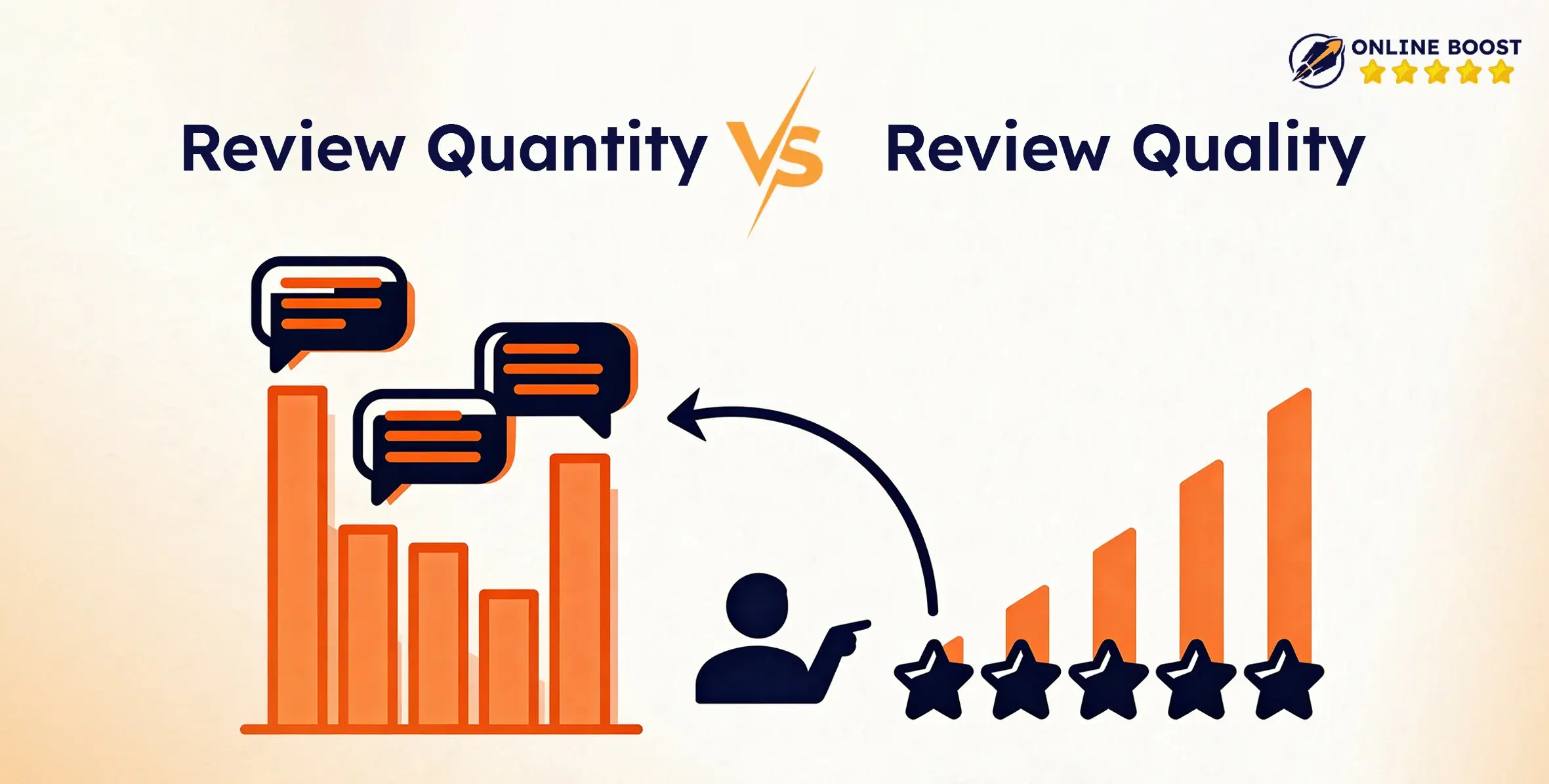
Many think that having 500 reviews automatically builds trust. But customers care about recent activity, not just totals. A business with fewer but consistent reviews wins over one with a large but outdated review count.
Here is the difference.
Key Difference Table
| Factor | Review Velocity | Review Volume |
|---|---|---|
| Meaning | Speed and consistency of new reviews | Total number of reviews |
| Focus | Ongoing activity | Lifetime accumulation |
| Customer perception | “This business is active and reliable” | “This business was popular at some point” |
| SEO impact | Strong ranking signal over time | Helpful but weaker alone |
| Trust factor | High if consistent | Low if reviews are old |
| Business impact | Drives steady growth and engagement | Builds authority but not momentum |
Example: Two Coffee Shops
- Shop A: 1,200 total reviews, last review 8 months ago
- Shop B: 180 reviews, gets 8 new reviews every week
Most customers choose Shop B because fresh online reviews reduce uncertainty.
Review Velocity vs Review Recency
Review recency focuses on how recent the latest review is. Review velocity focuses on how often reviews come in over time.
They are connected but not the same.
Key Difference Table
| Factor | Review Velocity | Review Recency |
|---|---|---|
| Meaning | Frequency of incoming reviews over time | How new the latest review is |
| Time focus | Pattern and consistency | Most recent timestamp |
| Customer mindset | “People regularly use this business” | “Someone used this business recently” |
| Data measurement | Reviews per week/month trend | Date of last review |
| Business value | Shows ongoing performance | Shows current relevance |
| Long-term impact | Sustains reputation and visibility | Supports freshness perception |
Example: Home Repair Company
- Gets 15 reviews every month = strong velocity
- Latest review yesterday = strong recency
That combination sends a powerful trust signal.
Now imagine this instead:
- Last review yesterday
- Only 2 reviews in the entire year
That shows recency but weak velocity. Customers may still question reliability.
Why Review Velocity Matters for Business Growth

Now that you understand what it is, let’s discuss the real question on your mind: why should you even care about review velocity?
Because it directly affects how customers trust you, how search engines rank you, how your reputation grows, and ultimately how much revenue your business generates.
Builds Instant Trust With Potential Customers
Trust is the first thing customers look for before buying anything. And trust today is built through visible proof.
When people see a steady stream of online reviews, their brain interprets it as reliability and safety. Consistent feedback signals that real customers are continuously interacting with your business.
Because customers think: “If many people are using this business regularly, it must be trustworthy.”
But here is the key part: Customers trust patterns, not just ratings.
Example: Choosing a Local Plumber
- Business A: 4.7 stars, 300 reviews, last review 6 months ago
- Business B: 4.5 stars, 120 reviews, 5 new reviews this week
Most customers choose Business B, because recent and consistent customer feedback reduces uncertainty.
Increases Conversion Rates and Sales
Trust does not just feel good. It drives revenue.
Harvard Business School found that a one-star rating increase can boost revenue by 5% to 9% for local businesses. But consistent incoming reviews amplify this effect because they create ongoing credibility.
When customers see steady positive feedback, they feel confident moving forward.
Businesses with strong review velocity often see:
- Higher click-through rates from search results
- More inquiries and bookings
- Faster customer decision-making
- Increased repeat purchases
Improves Search Visibility and Rankings
Search engines want to show users the most relevant and trustworthy businesses. Consistent review activity helps them identify which businesses are active.
Google’s local ranking factors include:
- Review quantity
- Review quality
- Review frequency
- Review freshness
- Customer engagement with reviews
Notice the pattern. Consistency appears multiple times.
A steady review flow signals:
- The business is active
- Customers interact with it regularly
- Information is current
- Reputation is continuously verified
This helps businesses appear more in local search results, maps, and “near me” searches.
Example: Two Restaurants in Chicago
- Restaurant A: 2 to 3 reviews every week
- Restaurant B: 30 reviews once a year
Restaurant A typically performs better in local visibility because its activity appears more natural and current.
Strengthens Brand Reputation Over Time
Reputation is not built in one moment. It is built from repeated positive experiences.
A steady flow of reviews creates a strong narrative about your brand. It shows that your business consistently delivers value, not just occasionally.
This helps businesses:
- improve brand reputation naturally
- Build long-term credibility
- Reduce damage from occasional negative reviews
- Create a balanced public image
When customers see consistent feedback over time, they do not focus on one negative comment. They look at the bigger pattern.
Keeps Your Business Relevant in Customer Perception
Customers want businesses that are active and current. A steady review flow shows your business is still serving people today.
Without recent activity, customers wonder:
- “Is this business still operating normally?”
- “Has service quality changed?”
- “Are people still using them?”
Review velocity answers these concerns without you saying a word. It communicates ongoing performance and relevance.
Creates Continuous Customer Engagement
When businesses actively encourage and respond to reviews, they create ongoing relationships with customers.
This supports better review management and stronger engagement cycles.
Consistent review activity encourages businesses to:
- Listen to customer feedback regularly
- Improve services based on real experiences
- Maintain communication with customers
- Show responsiveness publicly
Provides Actionable Business Insights
Reviews are not just marketing tools. They are data.
A steady flow of feedback helps businesses identify:
- Service issues early
- Product improvements
- Customer expectations
- Competitive advantages
- Market trends
Businesses that actively get online reviews gain continuous insight into what customers actually want.
Creates Competitive Advantage in Crowded Markets
In many industries, multiple businesses offer similar services. Customers compare them quickly using reviews.
The business with steady review activity appears more trustworthy and established.
Example: Two Fitness Studios
| Studio | Review Activity |
|---|---|
| Studio A | 500 total reviews, no new reviews in 7 months |
| Studio B | 150 reviews, 10 new reviews monthly |
Most customers choose Studio B because it appears more active and reliable.
Encourages More Customers to Leave Reviews
There is a psychological effect called “social proof momentum.”
When customers see many recent reviews, they feel more motivated to share their own experience.
They think:
“Others are sharing their feedback, so I should too.”
This creates a cycle:
- Consistent reviews = more trust
- More trust = more customers
- More customers = more reviews
What Happens When Reviews Are Inconsistent
When reviews stop coming in regularly, the impact is not always obvious at first. But over time, inconsistent review activity can quietly damage trust, visibility, and growth.
Loss of Customer Trust
When customers see outdated or irregular online reviews, they start questioning the reliability of your business. Their first thought is often: “Is this business still delivering the same quality?”
Decline in Search Visibility
Search engines prioritize businesses that show ongoing activity. When your review flow slows down, your relevance signal weakens. Platforms like Google favor businesses with consistent engagement because they appear more active and reliable.
Negative Impact on Brand Reputation
Reputation depends on patterns. When reviews are inconsistent, a single negative review can carry more weight and shape public perception. Without steady positive feedback, it becomes harder to improve brand reputation or maintain a balanced image.
Slower Business Growth
Inconsistent review activity breaks the momentum that drives business growth through reviews. Fewer reviews mean fewer trust signals, fewer conversions, and slower customer acquisition.
Competitive Disadvantage
Customers compare businesses side by side. If your competitor shows steady review activity and you do not, they appear more reliable and relevant. Even with similar services, consistent review activity gives competitors a clear advantage.
What a Healthy Review Velocity Looks Like

At this point, you might be thinking, “I understand the importance. But how many reviews are actually enough?”
That is the right question. Because a healthy review flow is about maintaining a consistent and natural pattern of incoming feedback that builds trust over time.
Consistency Matters More Than Quantity
Many business owners assume they need hundreds of reviews quickly. That is not true. Customers and search platforms prefer steady activity over sudden bursts.
A healthy pattern looks like:
- Reviews coming in every week or month
- Gradual growth in total reviews
- No long gaps in customer feedback
- Natural variation, but consistent flow
Example: Local Hair Salon
Healthy Pattern
- Week 1 → 3 reviews
- Week 2 → 2 reviews
- Week 3 → 4 reviews
- Week 4 → 3 reviews
This shows natural and consistent activity.
Unhealthy Pattern
- Month 1 → 0 reviews
- Month 2 → 40 reviews
- Month 3 → 0 reviews
This looks unnatural and reduces trust.
Your Review Velocity Should Match Your Business Size
There is no universal number that works for every business. The right pace depends on how often you serve customers.
A coffee shop serving 200 customers daily will naturally generate more reviews than a law firm handling 10 clients per month.
The key idea is simple: “Your review activity should reflect your customer volume.”
General Benchmarks by Business Type
| Business Type | Healthy Monthly Reviews |
|---|---|
| Local service business (plumbing, cleaning, repair) | 5 to 15 reviews |
| Medical or dental practice | 8 to 20 reviews |
| Restaurant or retail store | 20 to 50 reviews |
| E-commerce store | 50+ reviews |
| Low-volume professional services (legal, consulting) | 3 to 10 reviews |
Review Frequency Should Show Ongoing Activity
Customers want proof that people are using your business today, not just in the past. A healthy review pattern shows ongoing engagement.
Strong indicators of healthy velocity include:
- New reviews every week
- Recent reviews within the last 7 to 30 days
- Continuous growth in total review count
- Regular customer interaction
Example: Choosing a Gym
- Gym A: last review 5 months ago
- Gym B: 12 reviews this month
Even if both have similar ratings, Gym B appears more trustworthy because of its consistent online reviews activity.
A Balanced Mix of Positive and Negative Reviews Is Normal
Many businesses think a perfect rating means a strong reputation. But customers often trust businesses with realistic feedback more than perfect scores.
A healthy review profile typically includes:
- Mostly positive reviews
- Occasional negative feedback
- Active responses from the business
- Visible engagement with customers
Growth Should Be Gradual and Sustainable
Healthy review velocity shows steady progress over time. You should see gradual increases in review count each month.
Example: Home Cleaning Service
- January → 6 reviews
- February → 9 reviews
- March → 11 reviews
- April → 13 reviews
This gradual increase shows improving customer engagement and better processes to get online reviews.
Tracking the Right Metrics Helps Maintain Healthy Velocity
To maintain a healthy review flow, businesses should monitor specific indicators regularly.
Key Metrics to Track
| Metric | Why It Matters |
|---|---|
| Reviews per month | Measures consistency |
| Review growth rate | Shows momentum |
| Average rating trend | Reflects service quality |
| Review response rate | Shows engagement |
| Recency of latest review | Shows current relevance |
The Simple Rule to Remember
If you want one easy rule, remember this:“A healthy review velocity is steady, consistent, and aligned with your customer activity.”
Tools and Methods to Monitor Review Velocity
If you cannot measure something, you cannot improve it. The same applies to review velocity.
Many businesses want to grow their reputation, but never track their review activity. They collect reviews randomly and hope for the best. That approach does not work if your goal is consistent growth and strong review management.
Monitoring your review flow helps you understand:
- Whether your review activity is increasing or declining
- How customers perceive your business
- When to take action to increase online reviews
- How your reputation compares with competitors
What You Should Track (Key Review Metrics)
Before choosing tools, you need to know what to measure. Here are the most important metrics businesses should monitor.
| Metric | What It Tells You | Why It Matters |
|---|---|---|
| Reviews per week or month | Your review frequency | Shows consistency and momentum |
| Review growth rate | Increase or decrease in total reviews | Indicates reputation progress |
| Average rating trend | Change in customer satisfaction | Reflects service quality |
| Review recency | How recent your latest review is | Shows business activity |
| Review response rate | How often you reply to feedback | Builds trust and engagement |
| Customer sentiment | Positive vs negative feedback trends | Helps improve operations |
For example, if your business receives 10 reviews monthly but drops to 2 reviews next month, that shows a problem in customer experience or the review request process.
Simple Manual Tracking Methods (For Small Businesses)
You do not always need advanced software to monitor review activity. Many small businesses start with simple tracking systems.
These methods are affordable, easy to implement, and effective.
Spreadsheet Tracking
A basic spreadsheet can help you monitor:
- Date of each review
- Review platform (Google, Yelp, Facebook)
- Star rating
- Customer feedback themes
- Response status
Platform Notifications
Most review platforms provide notification alerts when new reviews are posted.
Businesses can enable alerts on:
- Google Business Profile
- Yelp
- TripAdvisor (if relevant)
Review Monitoring and Reputation Management Tools
As your business grows, manual tracking becomes difficult. This is where dedicated tools help automate review monitoring and analysis.
These platforms collect reviews from multiple sources, track trends, and provide insights in one dashboard.
Popular Review Monitoring Tools Used in the U.S.
| Tool Type | What It Helps With |
|---|---|
| Review aggregation platforms | Collect reviews from multiple sites in one place |
| Reputation management software | Monitor ratings and customer sentiment |
| Customer experience tools | Analyze feedback trends and behavior |
| Local SEO platforms | Track review impact on search visibility |
These tools help businesses:
- Track review velocity automatically
- Monitor rating trends
- Identify service issues quickly
- Improve response time
- Support long-term review management strategy
Competitor Review Monitoring
A powerful but ignored method is tracking competitor review activity.
Monitoring competitors helps you understand:
- Their review frequency
- Customer satisfaction trends
- Service strengths and weaknesses
- Market expectations
If your competitor receives 20 new reviews monthly while you receive 5, it shows the need to improve your strategy to get online reviews consistently.
Setting Review Performance Goals
Monitoring becomes more effective when businesses set measurable targets.
Example Review Goals
- Gain 10 new reviews per month
- Maintain average rating above 4.5 stars
- Respond to 100% of reviews
- Reduce negative feedback trends
7-Day Setup Checklist
Follow this step-by-step plan to create a sustainable system for collecting and managing online reviews for a business.
Day 1: Audit Your Current Review Presence
Before improving anything, understand where you stand.
Check:
- Total number of online reviews across platforms
- Average rating on each platform
- Review frequency (how often reviews come in)
- Last review date
- Response rate to customer feedback
Write down your numbers so you can track improvement later.
Goal: Identify gaps and opportunities.
Example: Audit Result
- Google reviews: 82 reviews, last review 3 months ago
- Yelp reviews: 25 reviews, no responses
- Facebook reviews: inactive
Day 2: Identify Priority Review Platforms
You do not need to focus everywhere. Focus on where your customers already search.
Most U.S. businesses prioritize:
- Google Business Profile (highest impact on visibility)
- Yelp (strong for local services and restaurants)
- Facebook recommendations
- Industry-specific platforms, if relevant
Goal: Choose 1 to 3 primary platforms.
Day 3: Create a Simple Review Request Process
Customers rarely leave reviews unless asked. You need a repeatable system.
Create a standard process:
- Ask every satisfied customer
- Send a follow-up message after the service
- Provide direct review links
- Train staff to request feedback naturally
Keep your request simple and genuine.
Day 4: Reduce Friction for Customers
The easier it is to leave a review, the more reviews you will receive.
Make the process effortless:
- Share direct review links
- Use QR codes at checkout or location
- Add review links to receipts and emails
- Provide step-by-step instructions if needed
Customers should be able to leave a review in less than two minutes.
Goal: Remove barriers to participation.
Day 5: Set Up Review Monitoring and Alerts
You cannot manage what you do not see.
Enable notifications for new reviews and track activity regularly. This helps you maintain consistent review management.
Set up:
- Platform review alerts
- Weekly review tracking sheet
- Monthly review performance check
Day 6: Build a Review Response System
Responding to reviews increases trust and encourages more feedback.
Create response guidelines:
- Thank customers for positive reviews
- Address negative feedback professionally
- Offer solutions when possible
- Respond within 24 to 48 hours
Example: Response Approach
- Positive review: “Thank you for your feedback. We are glad you had a great experience.”
- Negative review: “We appreciate your feedback and would like to resolve this. Please contact us directly.”
Day 7: Set Measurable Review Goals
Consistency requires clear targets.
Set realistic goals based on your business size:
- Target number of monthly reviews
- Minimum response rate
- Average rating goals
- Review frequency benchmarks
Example Goals
| Goal | Target |
|---|---|
| New reviews per month | 10 |
| Average rating | 4.5+ |
| Response rate | 100% |
| Review response time | Within 24 hours |
What Happens After the First 7 Days
Once this system is in place, your focus shifts from collecting random reviews to building consistent momentum.
You will begin to see:
- More regular customer feedback
- Higher trust from potential customers
- Stronger reputation signals
- Improved visibility and credibility