


































People do not usually choose the business with the biggest name. They choose the one that feels easiest to trust.
That is exactly why local search engine optimization matters so much. When someone in your city searches for a service, they usually want a place, a phone number, and a solution.
Google itself says local rankings are shaped mainly by relevance, distance, and prominence, which means the businesses that match the search clearly and build stronger local trust signals get seen first.
Did you know?
Google’s research has shown that mobile searches containing “can I” or “to buy” with “near me” grew more than 6 times in two years, and “store open near me” searches grew by over 250% in two years.
Another Google study found that 76% of people who conduct a local search on their smartphone visit a business within 24 hours, and 28% of those searches result in a purchase.
So when you work on local SEO, you are trying to meet people at the exact moment they are ready to decide. That is how you improve local search visibility without wasting effort on the wrong audience.
If you have ever wondered why a competitor in your city keeps getting the clicks and the customers, the answer is clearer positioning, better Google My Business optimization, stronger on-page SEO, and a smarter approach to get reviews.
What is Local Search Engine Optimization
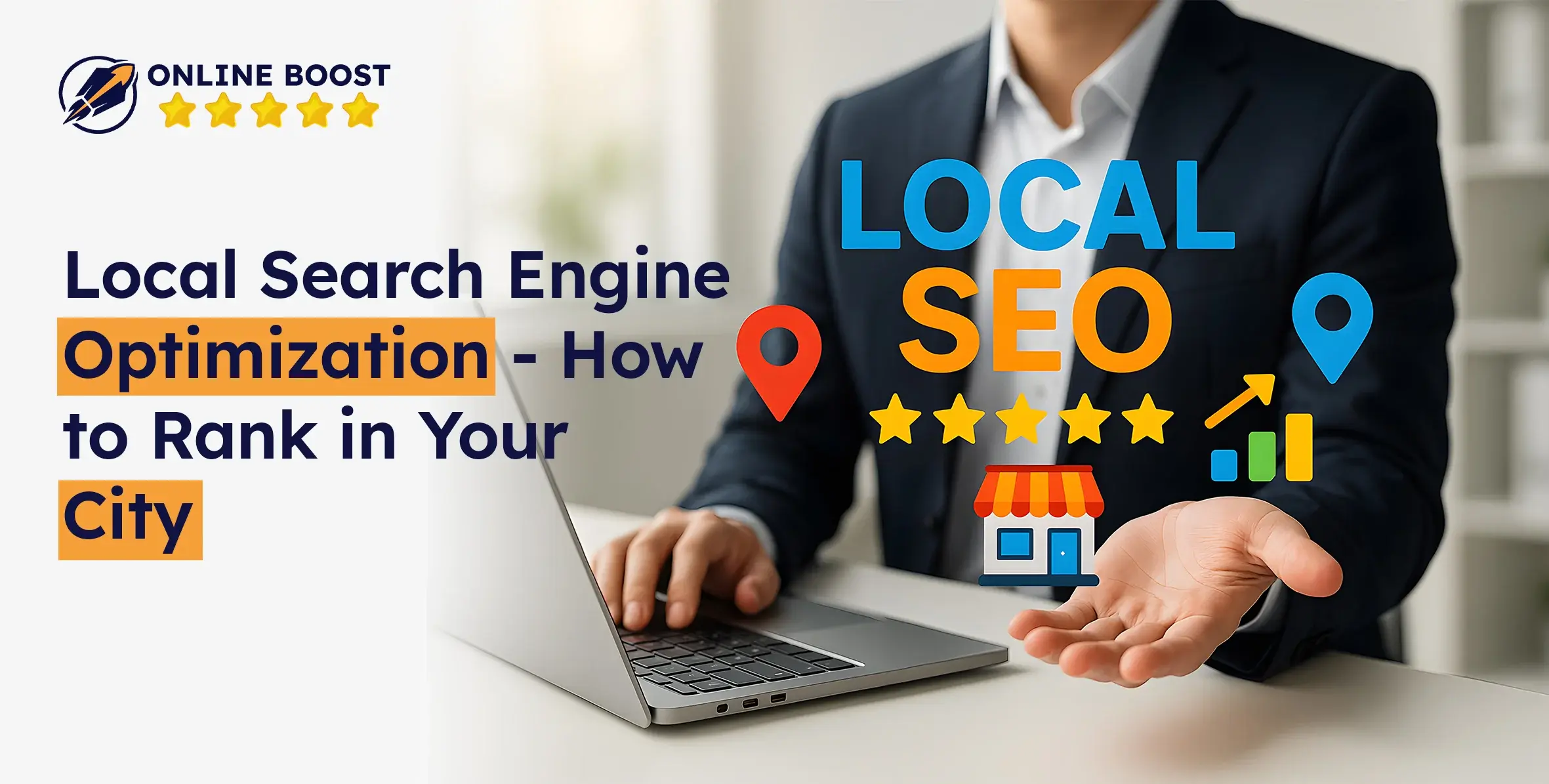
Local search engine optimization is the process of helping your business appear in search results when people in your specific area are looking for what you offer. It is about connecting your business with people who are physically close and ready to take action.
You can think of it like this:
- Traditional SEO brings visitors to your website
- Local SEO brings customers to your doorstep
For example: If someone searches “how to fix a leaking tap,” Google shows blog posts and guides.
But if someone searches “Digital marketing agency in Fort Lauderdale, FL,” Google shows:
- Local business listings
- Map results
- Contact details
- Online reviews
How Local SEO Differs from Traditional SEO
Many people assume search engine optimization is the same everywhere. It is not.
Yes, both local and traditional SEO aim to rank on Google, but the way they work and what they prioritize are very different.
Here is a clear comparison:
| Factor | Local SEO | Traditional SEO |
|---|---|---|
| Goal | Show your business in a specific city or area | Rank content globally or nationally |
| Search Intent | High intent, action-based searches | Informational or research-based searches |
| Example Search | “pizza shop in Florida” | “how to make pizza at home” |
| Results Type | Map listings, local pack, business profiles | Blog posts, articles, landing pages |
| Key Focus | Location relevance and trust signals | Content quality and backlinks |
| Platform Importance | Heavy focus on Google Business Profile | Focus on website and content |
| Trust Signals | online reviews, ratings, local mentions | Backlinks, domain authority |
| Audience | People ready to visit, call, or buy | People looking for information or options |
If you want to understand it in one line, here it is:
“Traditional SEO helps people find information. Local SEO helps people find you.”
How Local SEO Works

Let’s say someone in New York searches “best pizza near me” or someone in Dallas types “roof repair service.” At that moment, Google follows a clear process to decide which businesses to show first.
Here is how local search engine optimization works, step by step.
It Starts with a Local Search
Everything begins with intent.
Searches like:
- “plumber near me”
- “coffee shop in Chicago”
- “emergency electrician Los Angeles”
These searches tell Google one thing. The user wants a nearby solution and probably wants it soon.
Google Matches the Search with Relevant Businesses
Now Google looks for businesses that clearly match what the user is searching for.
It checks:
- Your business category
- Your listed services
- Your website content
- Your keywords
If your business does not clearly explain what you do and where you operate, Google gets confused and moves on to someone else.
Location Becomes a Deciding Factor
In the U.S., location signals are very strong.
Google uses:
- The searcher’s GPS location (especially on mobile)
- Your business address
- Your defined service areas
If your business is closer and clearly tied to that city, your chances increase.
Trust Signals
Google looks at:
- Your online reviews and ratings
- How frequently you receive reviews
- Customer engagement with your listing
- Overall reputation of your business
In the U.S., people rely heavily on reviews before choosing a business. That is why you need a system to consistently get online reviews.
Google Displays the Final Results
After analyzing everything, Google shows:
- The local pack (top 3 businesses with a map)
- Google Maps results
- Organic listings below
The businesses that appear here are the ones that:
- Match the search clearly
- Are close to the user
- Have strong trust signals
Types of Local Search Queries
Before you try to improve your rankings, you need to understand how people actually search. Not every local search looks the same, and each type shows a different level of intent.
Here are the main types of local search queries you should know:
“Near Me” Searches
These are very common and highly intent-driven.
Examples:
- “gym near me”
- “pharmacy near me”
Users want something close and immediate. Google uses their location to show nearby businesses.
City-Based Searches
These include a specific location in the query.
Examples:
- “dentist in Miami”
- “best restaurants in Austin”
Here, users are still location-focused but slightly more selective.
Service + Location Searches
These are more specific and often lead to conversions.
Examples:
- “emergency plumber in Chicago”
- “roof repair service in Houston”
Users know exactly what they need. If your local business SEO clearly matches the service and location, your chances of ranking increase significantly.
Branded Local Searches
These include a business name with a location.
Examples:
- “Starbucks in Seattle”
- “Nike store near me”
Users already have a business in mind. At this stage, strong online reviews and accurate listings help confirm their decision.
“Best” or “Top Rated” Searches
These are driven by trust and comparison.
Examples:
- “best hair salon in Los Angeles”
- “top rated car dealership near me”
Users are looking for proof before choosing. This is where you need to actively get reviews and maintain a strong reputation to stand out.
How to Rank in Your City – Step by Step
If you follow these steps properly, you will not just see an online boost. You will start getting calls, leads, and customers.
Step 1: Define Your City and Service Area Clearly
Before anything else, you need clarity.
Ask yourself:
- Which city or cities do I want to rank in?
- Do I serve one location or multiple areas?
For example, if you are a plumber in Dallas, your focus should not be “plumbing services in USA.” It should be:
- “plumber in Dallas”
- “emergency plumbing Dallas TX”
The clearer your location focus is, the easier it becomes for Google to understand where to show you.
Step 2: Choose the Right Local Keywords
You need keywords that match real searches in your city. Focus on:
- Service + city (dentist in Miami)
- Service + near me (used naturally in content)
- Problem-based searches (emergency AC repair Houston)
Your goal is not just traffic. Your goal is intent.
Step 3: Set Up and Optimize Your Google Business Profile
If you skip this, nothing else works properly.
Your profile is one of the strongest signals for local SEO. This is where most of your visibility comes from.
Make sure you:
- Use your exact business name consistently
- Choose the correct primary category
- Add all relevant services
- Upload real photos of your business
- Write a clear business description with your main services
Also:
- Keep your hours updated
- Add your service areas
- Post updates regularly
Step 4: Make Your Website Location-Focused
Your website should clearly support your local presence.
Here is what you need:
- A homepage that mentions your main city
- Service pages that include location keywords naturally
- Dedicated location pages if you serve multiple cities
For example:
Instead of one generic page, create:
“Roof Repair in Phoenix”
“Emergency Roof Repair Phoenix AZ”
This is where proper on-page SEO makes a real difference.
Make sure:
- Your title tags include your service + city
- Your headings match user intent
- Your content actually explains your service clearly
Step 5: Keep Your Business Information Consistent Everywhere
Your business name, address, and phone number must be the same across the internet.
This includes:
- Your website
- Business directories
- Social profiles
Even small differences can confuse Google.
Step 6: Get Reviews and Build Trust
People rely heavily on online reviews before choosing a business.
You need a simple system to get reviews consistently:
- Ask satisfied customers directly
- Send follow-up messages after service
- Make it easy for them to leave a review
Also:
- Respond to every review
- Stay professional, even with negative reviews
Step 7: Build Local Authority Signals
Now you need to show Google that your business is part of the local community.
You can do this by:
- Getting mentioned on local websites
- Partnering with local businesses
- Joining local directories
These signals improve your local search visibility and strengthen your presence in your city.
Step 8: Stay Active and Keep Optimizing
Ranking is not a one-time task.
You need to:
- Update your content
- Add new photos to your profile
- Keep getting reviews
- Monitor your performance
How to Target the Right City Keywords

This is where many businesses go wrong without even realizing it. They either target very broad keywords or guess what people might search.
But in local SEO, guessing does not work.
Start with How People Actually Search
People do not search in complicated ways. They keep it simple and direct.
They usually combine:
- A service
- A location
For example:
- “family dentist in San Diego”
- “car repair shop Chicago”
- “best pizza in Brooklyn”
Your job is to identify these exact patterns and use them naturally in your content.
Focus on Intent, Not Just Keywords
Not all keywords are equal.
Some people are just exploring, while others are ready to take action. You want to target keywords that show clear intent.
High-intent examples:
- “emergency plumber in Houston”
- “same day AC repair Phoenix”
Lower intent:
- “how AC repair works”
Use Variations of City-Based Keywords
Do not rely on just one version of a keyword.
People search in different ways, even within the same city.
For example:
- “dentist in Los Angeles”
- “Los Angeles dentist”
- “dentist near me”
Google understands these variations, but using them naturally across your content improves your local search visibility.
Place Keywords Where They Actually Matter
Using the right keywords is important, but placing them correctly is what makes them work.
Focus on:
- Page titles
- Headings
- First few lines of your content
- Service descriptions
Avoid Overstuffing Keywords
This is a common mistake. Trying to repeat the same keyword again and again does not help. It makes your content harder to read and can hurt your rankings.
Instead:
- Write naturally
- Use variations
- Focus on clarity
Common Local SEO Mistakes to Avoid
When working on local SEO, many businesses do the right things but still don’t see results because of small mistakes. These mistakes are common, and once you fix them, you usually start noticing improvement in your local visibility.
Ignoring Google Business Profile Optimization
Some businesses either do not set up their profile properly or leave it incomplete. Missing details, wrong categories, or no updates can limit your visibility.
Using Wrong or Broad Keywords
Targeting general keywords instead of city-based ones is a common issue. If your keywords do not clearly include your service and location, Google will not understand where to rank you.
Inconsistent Business Information
If your business name, address, or phone number is different across platforms, it creates confusion for Google. Consistency is important for trust and for improving your local SEO.
Not Focusing on Website Optimization
Many people rely only on their business profile and ignore their website. Without proper on-page SEO, your overall presence becomes weak.
Not Getting Enough Reviews
If you are not actively trying to get reviews, you are missing an important signal. Online reviews help users decide and also tell Google that your business is active and reliable.
Keyword Stuffing
Trying to force keywords again and again into your content does more harm than good. It makes your content harder to read and does not improve rankings.
How Long Local SEO Takes
The honest answer is simple. Local search engine optimization takes time, but you can start seeing movement earlier than most people expect if things are done correctly.
Here is a timeline so you know what to expect.
First 2 to 4 Weeks
In the beginning, you usually work on setup and fixes.
This includes:
- Proper Google My Business optimization
- Fixing business information
- Improving basic on-page SEO
At this stage, you may not see major rankings yet, but your local visibility starts improving slowly.
1 to 3 Months
This is where you start seeing actual progress.
You may notice:
- Your business appearing for some local searches
- Better positions in Google Maps
- Increased calls or clicks
3 to 6 Months
Now the results become more stable.
You can expect:
- Better rankings for your main city keywords
- More consistent traffic and leads
- Stronger presence in local results
6+ Months
At this point, your growth depends on consistency.
If you continue:
- Updating your profile
- Getting online reviews
- Improving your content
Tools for Local SEO
You do not need too many tools, but the right ones help you understand what people are searching, where your business stands, and what needs improvement.
Keyword Research Tools for Local Queries
These tools help you find what people in your city are actually searching for, so you can target the right keywords.
Tools for Listings and Citation Management
These tools help you manage your business information across different platforms and keep it consistent.
Tools for Rank Tracking and Audits
These tools help you track your rankings, monitor performance, and identify issues that affect your local visibility.